When something in your business isn’t working, it’s natural to look for an answer.
You look at what could be improved, what needs more attention, who needs to be involved or what needs to change. That’s part of running a business. You’re the person expected to make decisions, solve problems and keep things moving.
But sometimes the biggest opportunity isn’t in finding the next answer.
It’s in challenging the question you’re asking in the first place.
Without realising it, the question itself may already be narrowing your options before the conversation has even begun.
| The Question | The Hidden Assumption |
| How can we sell more of this service? | We’ve already decided the service shouldn’t change. |
| How can the team manage this work more effectively? | We’ve assumed the work still needs to be done this way. |
| How can we make this client relationship easier? | We’ve assumed continuing the relationship is the right decision. |
Those assumptions may be completely reasonable, but you’re also the person who can question them. Your team may be able to improve the process, adjust the offer or take on more responsibility, but you may be the only person who can decide whether the work should stop, the offer should change or the relationship should come to an end.
Challenging yourself doesn’t mean assuming everything is wrong. It simply means giving yourself permission to look again. Sometimes you’ll confirm you’re on the right track. Other times, you’ll uncover an opportunity that has been there all along but hidden beneath a question that was never challenged.
A practical question often feels easier because it gives you something to work on. You can make a plan, hold a meeting, change the wording or try a different approach. Questioning the decision underneath it is far less comfortable.
You may have already invested time, money and energy. Other people may be involved. It may even have been your idea in the first place.
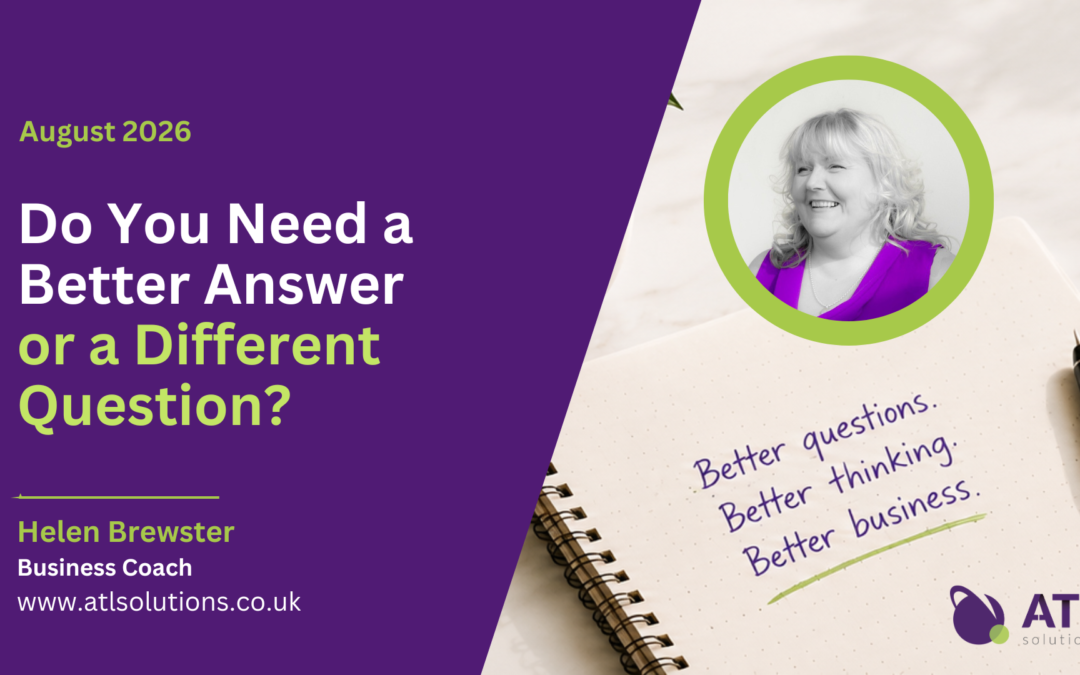
Earlier this year, I wrote about the difference between what a business could do and what it should do. The same thinking applies here. Sometimes the biggest step forward isn’t finding a better solution; it’s asking a better question.
When you’re close to your business, it’s easy to carry yesterday’s decisions into today’s challenges. You know why those decisions were made. You remember the conversations, the circumstances and what you hoped would happen. That knowledge is valuable.
It can also make it harder to recognise when an old decision is still shaping a current problem.
You know your business better than anyone else. You don’t need somebody to arrive with a generic plan and tell you what to do but if the same issue keeps returning, it might be worth stepping back before looking for another solution.
Ask yourself:
- What does this question assume has to stay the same?
- What have I already ruled out without meaning to?
- If I were making this decision for the first time today, would I ask the same question?
You won’t always uncover a dramatic answer.
Before you make your next decision, look at the question in front of you and notice what it has already treated as fixed. Your team may be able to improve what exists, but you may be the person who can decide whether it needs to exist in the same form at all.
You may still continue with the original plan. The difference is that it will be a decision you have looked at again, rather than one the business has carried forward without question.
A little about me
I’m Helen Brewster, founder of ATL Solutions. I work with business owners and senior leaders who need a trusted sounding board for decisions that can be difficult to think through alone.
Through one-to-one coaching and tailored business support, I help you challenge what has become fixed, explore different perspectives and decide what needs to happen next.
Sometimes that starts with the question you’re already asking. Sometimes it starts with the one you haven’t asked yet.